
Trends in bibliometric databases versus trends in research literature
analysis
Over time not only the landscape of scientific publications evolves, but also the bibliometric databases (not) indexing these publications changes. As part of our annual quality assurance analyses, KB compares the current and previous OpenAlex snapshots and publishes a report on its findings. The aim of this report is to identify from a bibliometric analyst’s perspective any potential changes in the data that may indicate quality or coverage issues.
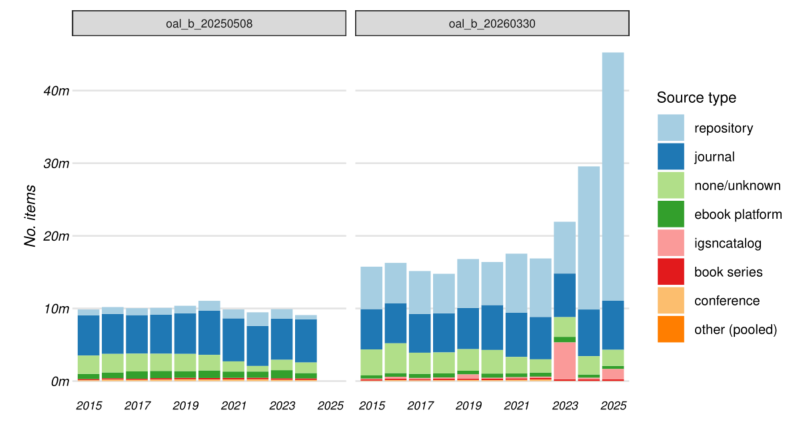
A comparison of the April 2025 and April 2026 OpenAlex snapshots shows substantial growth in the size of the database. A closer look at the structure of this growth, however, reveals an important pattern: most of the increase comes from sources other than journals. Figure 1 shows the total number of items in the two snapshots, broken down by source type. While the number of items from journals has remained relatively stable, the overall increase is primarily driven by items from repositories. Although repository content has increased throughout the period covered by the snapshots, the growth has been particularly pronounced in recent years.
Looking at the newly added items by document type provides further insight into this expansion (Figure 2). Of the items present in the April 2026 snapshot but absent from the April 2025 snapshot, approximately 40% are datasets, 28% are classified as “other”, and 24% are articles. The additions are mainly concentrated in the 2023–2025 publication years. This pattern suggests that the recent expansion of OpenAlex reflects a broader coverage of repository and dataset content, rather than a comparable increase in journal articles.
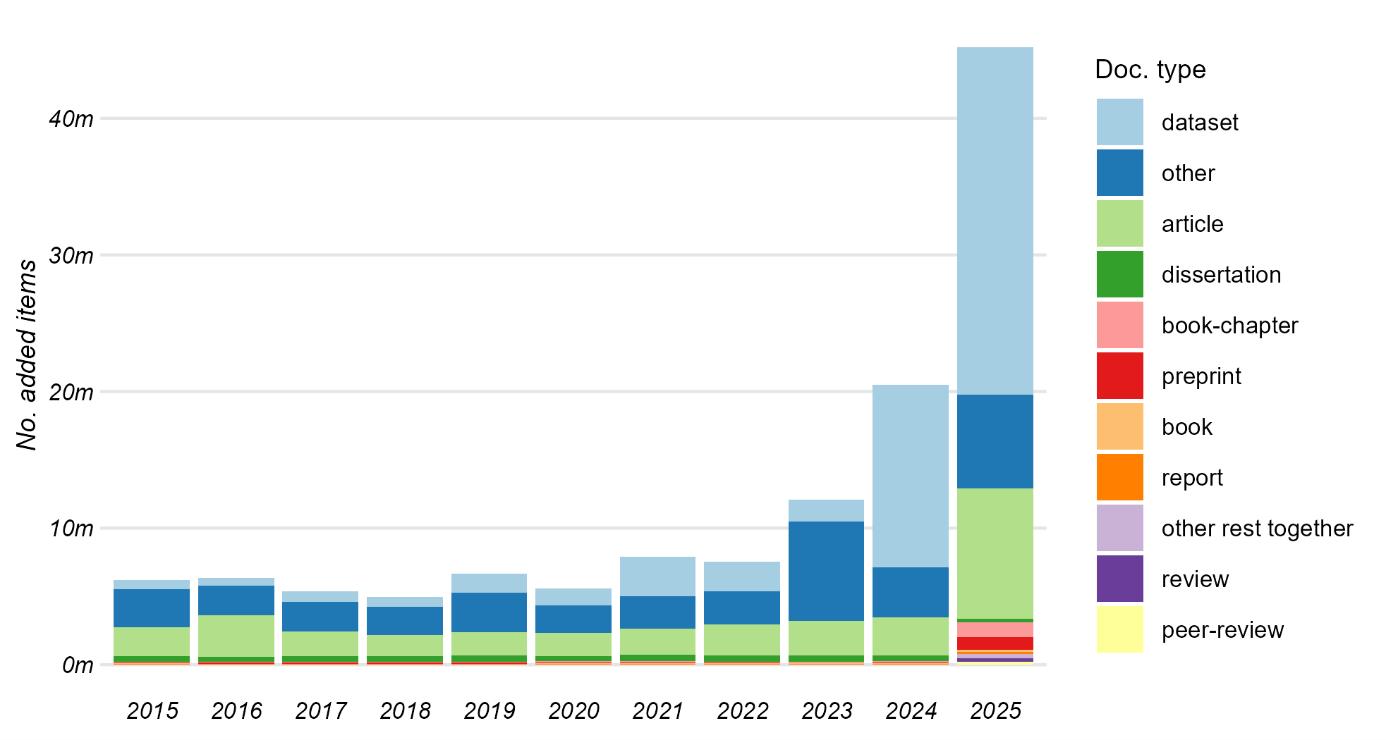
oal_b_20260330 but absent from oal_b_20250508) by document type.
This comparison highlights an important distinction between the growth of a bibliometric database and the growth of the research literature it represents. The substantial increase in the total number of OpenAlex items is largely a result of changes in the scope of its coverage. Indicators based on “all items” may show strong growth, while indicators that include datasets, repository records, and other content, in contrast, can increase substantially. This also means that changes in OpenAlex-based indicators must be interpreted in light of changes in database coverage. An increase in the number of indexed items does not necessarily reflect a corresponding change in the analysed research system.
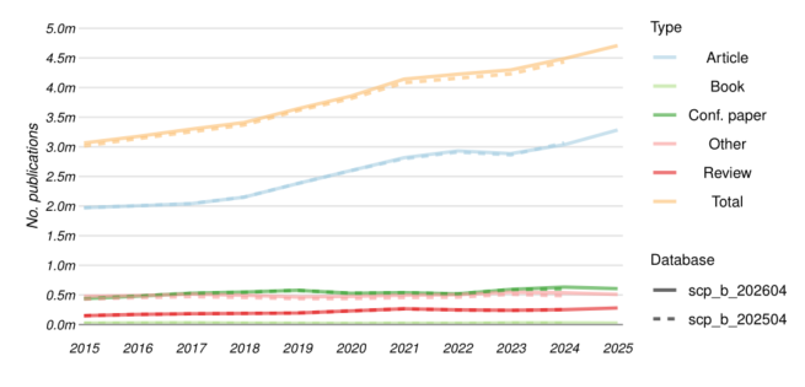
For comparison, our parallel quality-assurance analysis of Scopus revealed no comparable increase (Figure 3). As the Scopus macro-level quality-assurance report shows, the database was broadly stable between the two snapshots, and the deviations identified in the analysis were normal and easily explained. The contrast illustrates that growth in a bibliometric database can have very different causes, depending on the database and its coverage. Understanding these causes is essential for interpreting changes in bibliometric indicators.
To facilitate further comparisons between databases and time-varying snapshots, we have created the Database Dashboard. This interactive tool allows users to explore bibliometric database from various perspectives. The dashboard reveals the database’s complex structure, helping both specialists and non-specialists to interpret trends, identify biases, and understand its diversity.
Citation
BibTeX citation:
@online{lovakov2026,
  author = {Lovakov, Andrey},
  title = {Trends in Bibliometric Databases Versus Trends in Research
    Literature},
  date = {2026-11-11},
  url = {http://www.open-bibliometrics.de/posts/20261110-DatabaseDashbaord/},
  langid = {en}
}
For attribution, please cite this work as:
Lovakov, Andrey. 2026. “Trends in Bibliometric Databases Versus
Trends in Research Literature.” November 11. http://www.open-bibliometrics.de/posts/20261110-DatabaseDashbaord/.