
The current state of affiliation mapping in OpenAlex - A case study based on German universities in the federal state of Lower Saxony
analysis
In this blog post, we will explore the attribution of affiliations in OpenAlex for German universities in the federal state of Lower Saxony. As a basis of comparison, we use the institutional coding system of the Bielefeld University, which is provided by the Kompetenznetzwerk Bibliometrie (KB). An analysis of over 70,000 journal articles reveals a large overlap between both data sources. Building on these findings, we also present the preliminary results from our faculty mapping procedure, which can be used to assign affiliation strings to suborganisations within a given university.
Introduction
The accurate attribution of publications to institutions is a critical factor in determining the publication output of an academic organisation. Understanding an organisations own publication activity is helpful for the allocation of funding, policy-making and for university rankings. Whilst proprietary data sources have largely been used for this purpose in recent decades, OpenAlex has emerged as a new, freely accessible data source for monitoring publications. But to what extent do institutional affiliations in OpenAlex align with curated data from other sources?
This is exactly the question we have been investigating in our project. The project, HdN-FIS, funded by the German Ministry for Science and Culture of Lower Saxony, aims to establish a curated data pool for research publications within the federal state of Lower Saxony. For this task, we primarily rely on the OpenAlex data service. To compare the affiliation data in OpenAlex, we apply data from the Kompetenznetzwerk Bibliometrie (KB), which has developed its own institutional coding system for OpenAlex for German universities.
In this blog post, we present the interim results from our project. We explain how we combine data from OpenAlex and the KB database, and discuss the level of agreement in the affiliation assignements. Additionally, we present the preliminary results of an approach that allows suborganisations, such as faculties and departments, to be assigned to individual publications. For this, we use the GERiT service developed by the German Research Foundation (DFG).
An example of an unassigned affiliation
An affiliation string extracted from a publication is not always correctly assigned to an institution in OpenAlex. In the following example, we can see from the raw affiliation string field that the publication originates from the Unviersity Medical Center Göttingen. However, in this case, OpenAlex does not assign an institution ID. To identfy cases such as these on a larger scale, further data sources are requiered, which, ideally, should also be freely accessible.
- Example OpenAlex (https://openalex.org/works/W3019299956):
{
      "author_position": "middle",
      "author": {
        "id": "https://openalex.org/A5113894063",
        "display_name": "Lorenz Tr\u00fcmper",
        "orcid": null
      },
      "institutions": [

      ],
      "countries": [

      ],
      "is_corresponding": false,
      "raw_author_name": "Lorenz Tr\u00fcmper",
      "raw_affiliation_strings": [
        "Clinic for Hematology and Medical Oncology, University Medical Center Goettingen, G\u00f6ttingen, Germany"
      ],
      "raw_orcid": null,
      "affiliations": [
        {
          "raw_affiliation_string": "Clinic for Hematology and Medical Oncology, University Medical Center Goettingen, G\u00f6ttingen, Germany",
          "institution_ids": [

          ]
        }
      ]
    }
Data and Method
For the identification of missing or divergent institution assignments in OpenAlex, this project draws on work carried out by the Bielefeld University. Since more than a decade, the Bielefeld University has been developing an institutional coding system for the Kompetenznetzwerk Bibliometrie, which uses a pattern-matching approach to link raw affiliation strings in bibliographic databases (e.g., Scopus, Web of Science, OpenAlex) to institutions within the German higher education sector.
The institutional coding system distinguishes between 22 main entities (e.g., universities, companies, academies). For this project, we only extract the entities university, university of applied sciences, and university of art and music. The classification of organisation types slightly differs between KB and OpenAlex, because OpenAlex reuses types from the Research Organization Registry (ROR) (where in most of our cases the type education is assigned). When assigning affiliation strings to institutions, OpenAlex relies on classification through machine learning in combination with a rule-based approach.
Data sources:
OpenAlex: OpenAlex provides one of the largest databases of scholarly publications since 2022. The database aggregates data from a wide range of sources, including Crossref, DataCite, arXiv, as well as library repositories and data directly from publishers. OpenAlex releases publicly available, free-to-access database snapshots via Amazon Web Services (AWS) on a quarterly basis. A premium membership also provides unlimited daily access to new data. A limited search function is available via a web interface.
KB: The KB is a consortium of over 20 German research institutions with the goal of providing and analysing quality-assured bibliometric data for Germany. Funded by the Federal Ministry for Research, Technology and Space, it has been existing since 2008. Access to the KB data is available through a membership. In addition, selected KB products are made publicly available via Zenodo and Google BigQuery.
For this project, we are working with the Google service BigQuery. We have made the relevant datasets available via the Big Scholarly Data Warehouse of the Göttingen State and University Library (thanks to a CC0 license!). The public datasets allow anyone with a Google account to access and reproduce the data and results from this blog post.
The analysis presented in this blog post focuses on journal articles published between 2020 and 2024. As the KB data is based on the OpenAlex snapshot from March 2026 and the comparative OpenAlex snapshot is from June 2026, there may be differences in the data between these two snapshots. We tried to reduce the number of new articles introduced by the June snapshot by excluding the most recent publication years, 2025 and 2026, from this analysis. Also, we noticed that, between snapshots, an affiliation string may be changed, removed or added by OpenAlex.
The second part of this project aims to enrich publication metadata with information about suborganisations such as faculties, clinics and institutes. For this purpose, we use the GERiT service provided by the German Research Foundation (DFG). The GERiT directory contains a list of subordinate units for almost all higher education institutions in Germany, organised in a hierarchical structure. We use a pattern-matching approach to link individual affiliation strings in OpenAlex to existing suborganisations in GERiT. For pattern matching, we use regular expressions. The procedure was developed on top of the KB institutional coding system, but can also be applied easily on the institutional assignments in OpenAlex.
Analysis
Institutional comparison
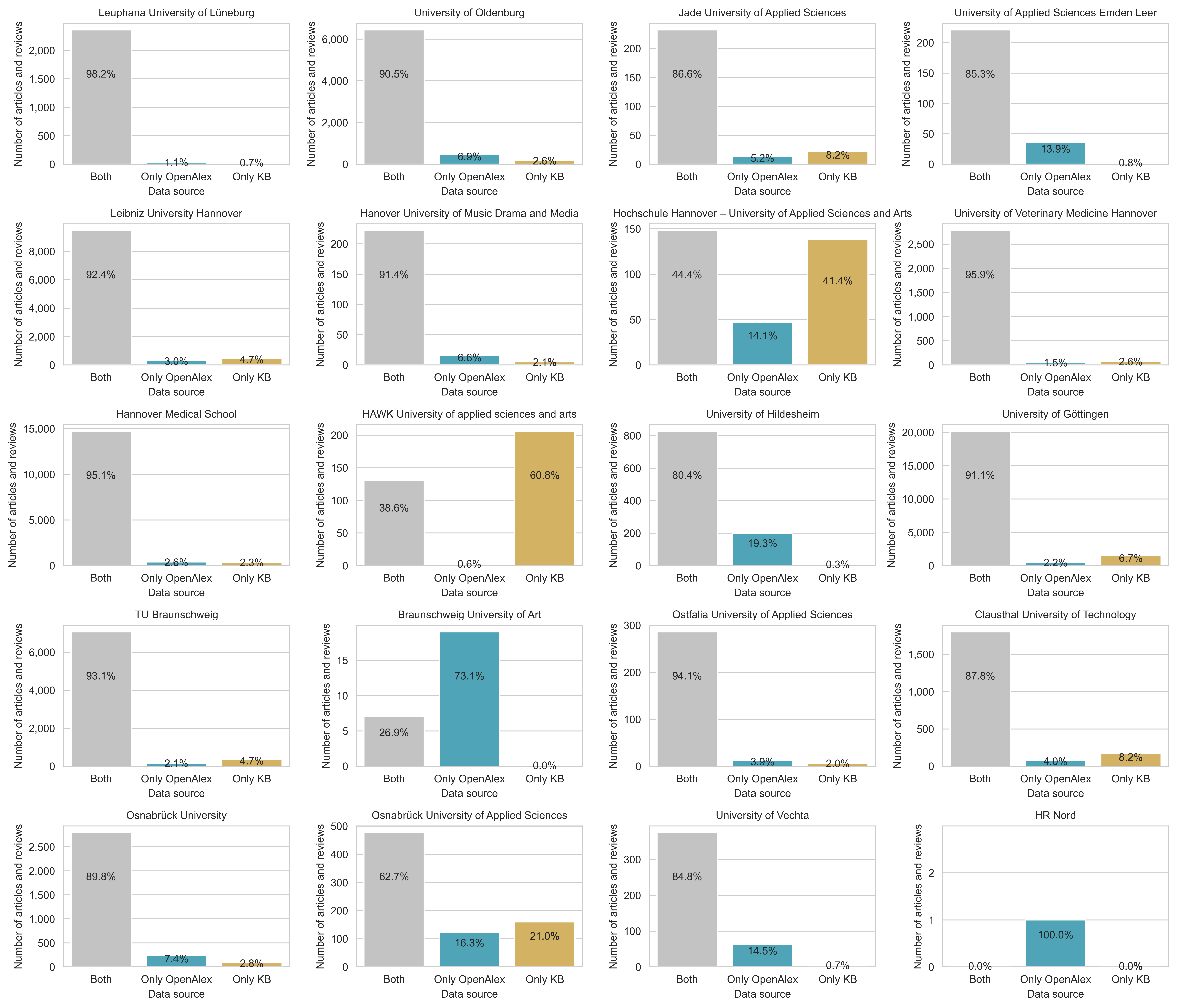
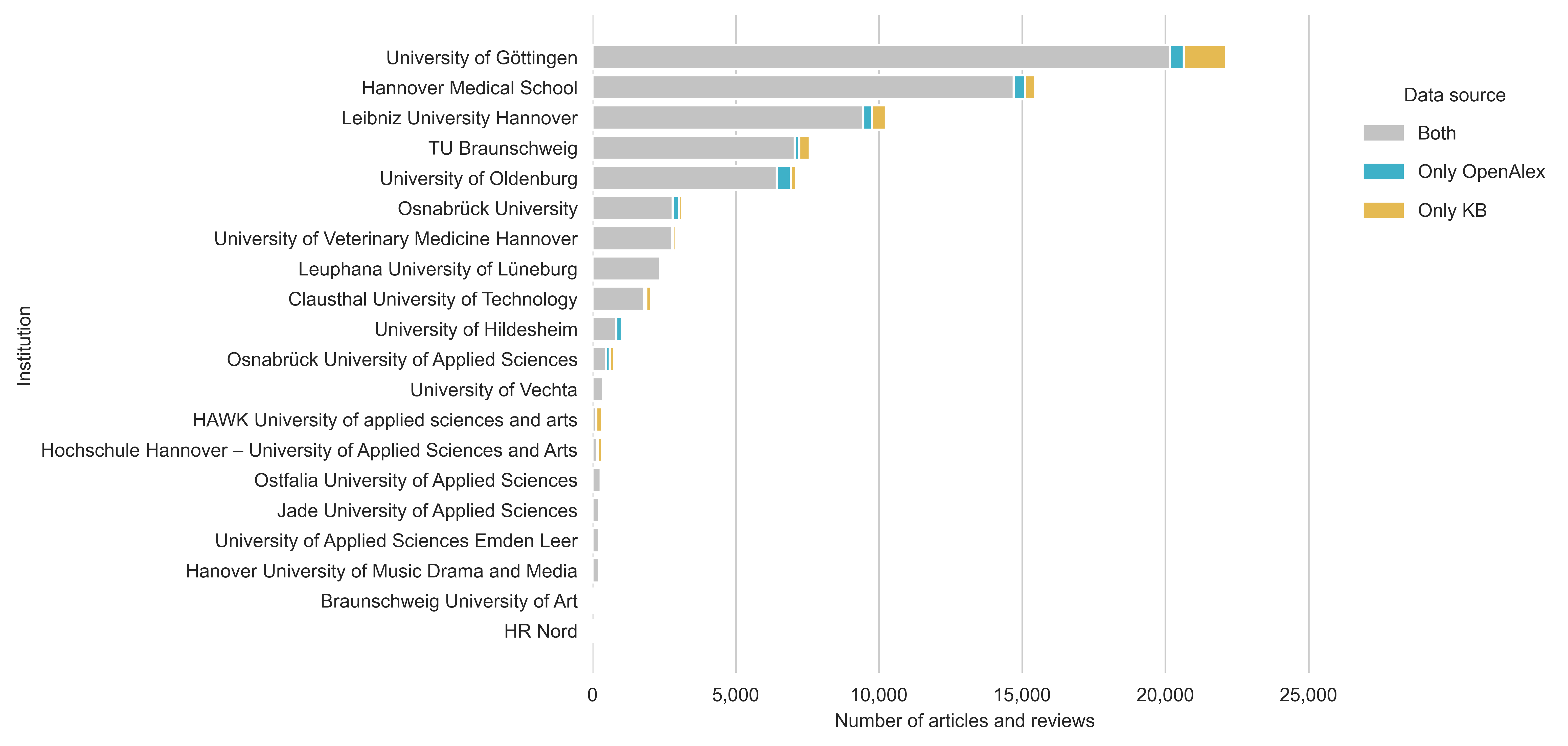
Below we compare the attribution of journal articles from universities in Lower Saxony in OpenAlex and in the Bielefeld institutional coding system. Figure 1 shows the proportion of articles attributed to an institution in both data sources, as well as the proportion of items linked to an institution in only one of the two data sources. For each publication, an affiliated institution is counted only once. That means, if several authors of an article belong to the same institution, the institution count is 1. In the case of multiple affiliations, each university is counted once, assuming that separate affiliation strings are provided.
If we now look at the figure, we can see that there is a substantial overlap in the attribution of publications to institutions. In total, 70,474 articles (91.5%) are attributed to the same institution by both data sources. 2,752 articles (3.6%) are only attributed to an institution by OpenAlex, and 3,756 articles (4.9%) are only assigned by the Bielefeld institutional coding system. These discrepancies vary from one institution to another. For example, the Hannover University of Applied Sciences is assigned more frequently by the KB (41.4%), whilst the proportion of articles attributed solely by OpenAlex amounts to 14.1%. One reason for the differing numbers is that articles are sometimes assigned to the Hannover University of Applied Sciences, even though they actually belong to the Medical School Hannover, Leibniz University Hannover or another (including private) university in Hannover. It also happens that publications from the Leibniz University Hannover or one of the other unviersites in Hannover are sometimes attributed to the Hannover University of Applied Sciences.
- Example OpenAlex (https://openalex.org/W3114667184) - Medical School Hannover was assigned, but Hannover University of Applied Science is correct:
{
    "raw_affiliation_string": "Hochschule Hannover \u2013 University of Applied Sciences and Arts, Fakult\u00e4t III, Department Information and Communication, Medical Information Management, Hannover, Germany",
    "institution_ids": [
        "https://openalex.org/I34809795"
    ]
}- Example KB (https://openalex.org/W3188060049) - Hannover University of Applied Science was assigned, but Leibniz University of Applied Sciences (private university) is correct:
Leibniz FH, University of Applied Sciences, Hanover, GermanyA brief explanation how such an error can occur in the KB: This incorrect assignment is due to the following pattern, which assigns all strings matching this pattern to the Hannover University of Applied Science.
%UNIV APPL SCI%HANNOVER% -> Hannover University of Applied ScienceAnother example is Osnabrück University of Applied Sciences. Here, the proportion of matching results is also lower. Often the discrepancy stems from confusion with the Osnabrück University.
- Example OpenAlex (https://openalex.org/W3043066866): Osnabrück University was assigned, but Osnabrück University of Applied Sciences is correct:
{
    "raw_affiliation_string": "University of Applied Sciences Osnabr\u00fcck, Faculty of Business Management and Social Sciences, Caprivistr. 30a, 49076, Germany",
    "institution_ids": [
        "https://openalex.org/I170658231"
    ]
}
The same applies to the Braunschweig University of Art. Here, publications are often incorrectly attributed to TU Braunschweig (or vice versa).
- Example OpenAlex (https://openalex.org/W4386834918): Assigned to Braunschweig University of Art, but TU Braunschweig University is correct:
{
    "raw_affiliation_string": "Department of Industrial, Organizational, and           Social Psychology, Braunschweig University of Technology, Germany",
    "institution_ids": [
        "https://openalex.org/I4210125722"
    ]
}- Example KB (https://openalex.org/W4394611326): Not captured by the KB, but correctly mapped to Braunschweig University of Art in OpenAlex:
HBK, Communication Arts, Braunschweig, GermanyA large proportion of articles assigned exclusively by the KB come from the University of Göttingen (in sum 1,481 articles). In some cases, where OpenAlex differs from the KB, OpenAlex does not assign an institution ID to an affiliation that belongs to the University of Göttingen.
- Example: Assigned to University of Göttingen by KB, but not in OpenAlex:
Math Institut Göttingen, Germany- Example: Assigned to University of Hildesheim by OpenAlex, but not by KB:
Hildesheim , Germany Faculty mapping
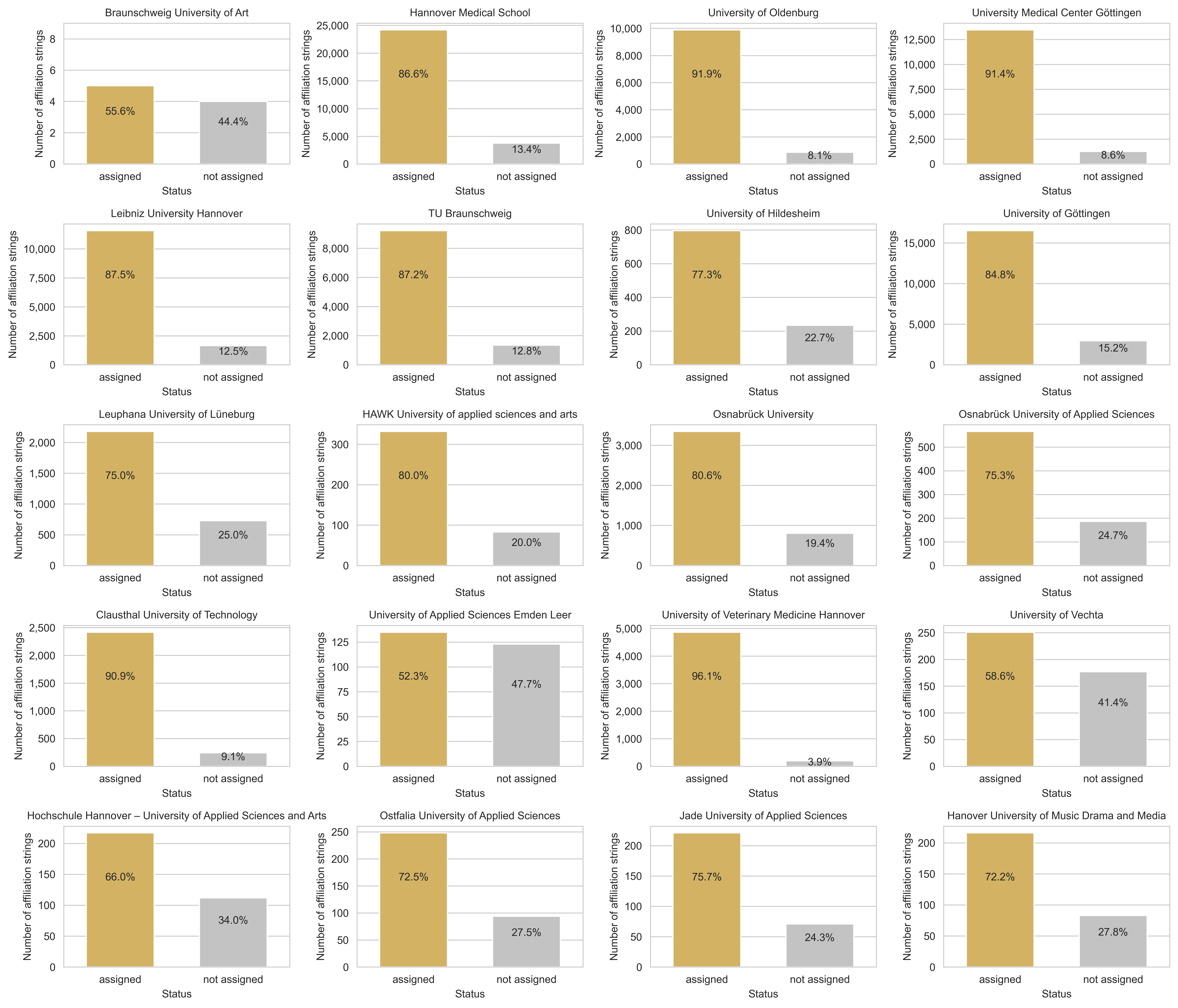
In the next section of this blog post, we will look at the current status of the faculty assignment within this project (see Figure 3). We will only compare the assignment to the top-level id in GERiT (which in most cases is a faculty or, in the cases of medical institutions, a clinic). The figure shows, for each affiliation string, whether our approach has automatically assigned an affiliation string to a faculty or not. Our rule-based approach rewards detailed information in the affiliations. A good example is the University of Veterinary Medicine Hannover where over 96% of articles could be assigned to a GERiT id. In contrast, only 52% of affiliations by the University of Applied Sciences Emden/Leer could be mapped to a faculty, because the raw affiliation strings often mention the university but not a specific suborganisation. In some cases, no GERiT id could be assigned because the affiliation string was incorrectly assigned to the wrong university, we missed a pattern, or because the affiliation string was inaccurate or contained an outdated name of an institution.
The faculty mapping can be tested using this Jupyter Notebook. The example is written in Python. Results are currently only available in German.
Possible Output:
{
    "doi": "10.1186/s12904-020-00573-6",
    "raw_affiliation_string": "Psychology of Language Department, University of Göttingen , Göttingen 37073, Germany",
    "parent_name": "Georg-August-Universität Göttingen", // University of Göttingen
    "parent_id": "https://gerit.org/de/institutiondetail/10236",
    "faculty": "Fakultät für Biologie und Psychologie", // Faculty of Biology and Psychology
    "faculty_id": "https://gerit.org/de/institutiondetail/13697",
    "department": "Georg-Elias-Müller-Institut für Psychologie", // Georg Elias Müller Institute of Psychology
    "department_id": "https://gerit.org/de/institutiondetail/16816",
    "institute": "Abteilung der Psychologie der Sprache", // Psychology of Language
    "institute_id": "https://gerit.org/de/institutiondetail/560902828",
    "author": {
        "id": "https://openalex.org/A5012202437",
        "display_name": "Rajalakshmi Madhavan",
        "orcid": "https://orcid.org/0000-0002-0830-563X"
    }
}
Summary
The interim results from our project demonstrate a high degree of overlap in the mapping of universities in Lower Saxony between OpenAlex and the KB. This suggests that OpenAlex already has a solid data foundation concerning the quality of the institutional mapping. That said, minor differences between the data sources can be spotted, which is why further curation is advisible in this case.
Our approach to map raw affiliation strings to suborganisations looks also very promising. We achieve a high matching rate thanks to the automatic mapping process. However assigning strings with GERiT IDs also has certain difficulties. For example, some affiliation strings contain outdated information about a faculty or mention an institution that is not listed in GERiT.
Appendix
Table with all public universities in Lower Saxony
| Institution | GERiT ID | ROR ID | Sector |
|---|---|---|---|
| Leuphana University of Lüneburg | 10232 | https://ror.org/02w2y2t16 | uni |
| University of Oldenburg 1 | 10233 | https://ror.org/033n9gh91 | uni |
| Jade University of Applied Sciences | 10533 | https://ror.org/02vvvm705 | fh |
| University of Applied Sciences Emden/Leer | 980710 | https://ror.org/01bc76c69 | fh |
| Leibniz University Hannover 2 | 10238 | https://ror.org/0304hq317 | uni |
| Hanover University of Music Drama and Media | 10246 | https://ror.org/00x67m532 | khmh |
| Hochschule Hannover – University of Applied Sciences and Arts | 10252 | https://ror.org/03m2kj587 | fh |
| University of Veterinary Medicine Hannover | 10249 | https://ror.org/015qjqf64 | uni |
| Hannover Medical School 3 | 10247 | https://ror.org/00f2yqf98 | uni |
| HAWK University of applied sciences and arts | 10253 | https://ror.org/00f5q5839 | fh |
| University of Hildesheim | 10235 | https://ror.org/02f9det96 | uni |
| University of Göttingen 4 | 10236 | https://ror.org/01y9bpm73 | uni |
| TU Braunschweig | 10240 | https://ror.org/010nsgg66 | uni |
| Braunschweig University of Art | 10251 | https://ror.org/03aft2f80 | khmh |
| Ostfalia University of Applied Sciences | 10254 | https://ror.org/01bk10867 | fh |
| Clausthal University of Technology 5 | 10242 | https://ror.org/04qb8nc58 | uni |
| Osnabrück University | 10244 | https://ror.org/04qmmjx98 | uni |
| Osnabrück University of Applied Sciences | 10255 | https://ror.org/059vymd37 | fh |
| University of Vechta | 10597 | https://ror.org/045y6d111 | uni |
| HR Nord 6 | https://ror.org/02743t710 | fh | |
| University Medical Center Göttingen 7 | https://ror.org/021ft0n22 | uni |
Abbreviations: uni = University, fh = University of Applied Sciences, khmh = University of Art and Music
Code Availability
The underlying code for this blog post can be found on GitHub: https://github.com/naustica/lower_saxony_institutions
To explore variations in the institutional assignment of distinct affiliation strings in OpenAlex and KB, we have created this interactive table. The information is in German. Note that the affiliation string sometimes changes between snapshots, which causes strings not be linked correctly.
Footnotes
Includes publications from the Institute for Economic Education, Institute for Chemistry and Biology of the Marine Environment, Institute for Information Technology, Klinikum Oldenburg, Evangelisches Krankenhaus Oldenburg, Pius Hospital Oldenburg and Helmholtz Institute for Functional Marine Biodiversity.↩︎
Includes publications from L3S Research Center and Forschungszentrum Küste.↩︎
Includes publications from Centre for Individualised Infection Medicine, Centre for Structural Systems Biology and Center for Experimental and Clinical Infection Research.↩︎
Includes publications from GWDG, Göttingen Campus Institute for Dynamics of Biological Networks, Campus Institute Data Science (CIDAS), Multiscale Bioimaging, Institute for Small Business Economics and Göttingen State and University Library.↩︎
Includes publications from Forschungszentrum Energiespeichertechnologien.↩︎
HR Nord is not included in the KB institutional coding system, because it has less than 15 publications.↩︎
The University Medical Center Göttingen is part of the Unviersity of Göttingen in the KB institutional coding system. Includes publications from Else Kröner Fresenius Center for Optogenetic Therapies and European Neuroscience Institute Göttingen.↩︎
Citation
BibTeX citation:
@online{haupka2026,
  author = {Haupka, Nick and Kaliuzhna, Nataliia and Lenke, Christopher},
  title = {The Current State of Affiliation Mapping in {OpenAlex} - {A}
    Case Study Based on {German} Universities in the Federal State of
    {Lower} {Saxony}},
  date = {2026-09-04},
  url = {http://www.open-bibliometrics.de/posts/20260908-HdNFIS/},
  langid = {en}
}
For attribution, please cite this work as:
Haupka, Nick, Nataliia Kaliuzhna, and Christopher Lenke. 2026.
“The Current State of Affiliation Mapping in OpenAlex - A Case
Study Based on German Universities in the Federal State of Lower
Saxony.” September 4. http://www.open-bibliometrics.de/posts/20260908-HdNFIS/.