
OpenAlex affiliation data coverage - August 2026 update
analysis
This post looks into the development of organization and address data of works in OpenAlex, following up on an observed decrease in coverage in a November 2025 snapshot.
As the coverage and data quality of OpenAlex is being continuously improved, users explore and independently assess the source’s utility for their specific purposes. An analysis by Najko Jahn of the affiliation data coverage of OpenAlex after the major codebase update Walden (November 2025) showed some unexpected decreases in the first post-Walden data snapshot. Enough time has passed to revisit this issue and see if these potential issues persist or were a one-time fluke due to the codebase transition.
Here we focus on the metadata field of raw affiliation strings only and compare two snapshots released prior to the Walden update and two post-Walden snapshots from this year to review developments over a somewhat longer time frame. Not all records with available raw affiliations string also have extracted data for fields such as organization name and ID. For articles from 2020-2025, 89% of those with raw affiliations have extracted organization names and country names.
We decided not to replicate Najko Jahn’s analysis because his data concerns a quite specific set of journals which are part of a Swedish open access transformation agreement. Instead, we opted for a broader overview with two further drilldowns into subsets of data of high interest. First, we look at OpenAlex’s data as a whole. Second, following Jahn’s observation of conspicuous data changes for publications from Elsevier, we look at the data associated with this publisher. Finally, to obtain a better insight into what affiliation data coverage level is available elsewhere, we compare the affiliation coverage of OpenAlex and Scopus for a subset of publications included in both data sources. In the following, we restrict all analysis to items coded by OpenAlex as type ‘article’.
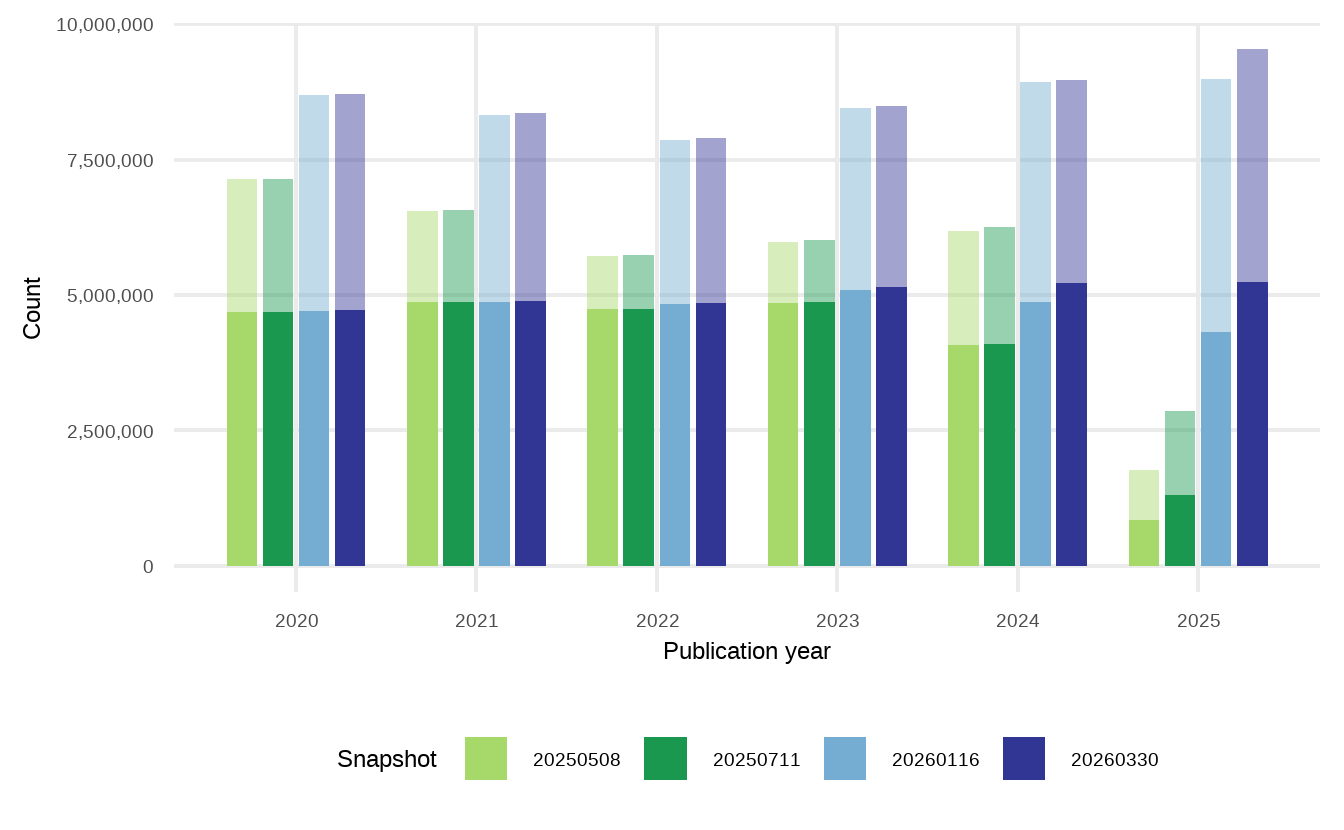
A first look at the broad picture of changes is presented in Figure 1, in which the two pre-Walden snapshots are in green and the second and third post-Walden snapshots of January and March 2026 are in blue. Shown are the total numbers of ‘article’-type records and the number of those with any raw affiliation data in the four snapshots for the publication years from 2020 to 2025. Note that the bottom part of the bars in the darker shades shows items with affiliation data while the lighter shaded top parts represents items without affiliation metadata.
While the number of indexed articles has increased strongly, the absolute number of articles with affiliation data has not increased commensurately – particularly for 2020 to 2023 for which almost all data would have been indexable by the date of the first considered snapshot. We can plausibly infer that for most of the additionally indexed articles no affiliations have been indexed but also that no affiliation data of previously indexed data has been lost. To confirm this, the affiliation data coverage for article records newly available in the 20260116 snapshot which were not present in the 20250711 snapshot (publication years 2020-2023) was calculated. The affiliation data coverage of this newly included subset of records was about 1 to 2% across these years. This confirms that additionally indexed records for past publications years for the most part have no affiliation data.
At the same time, this suggests that the percentage of articles with affiliation data has decreased. This is confirmed directly in Figure 2.

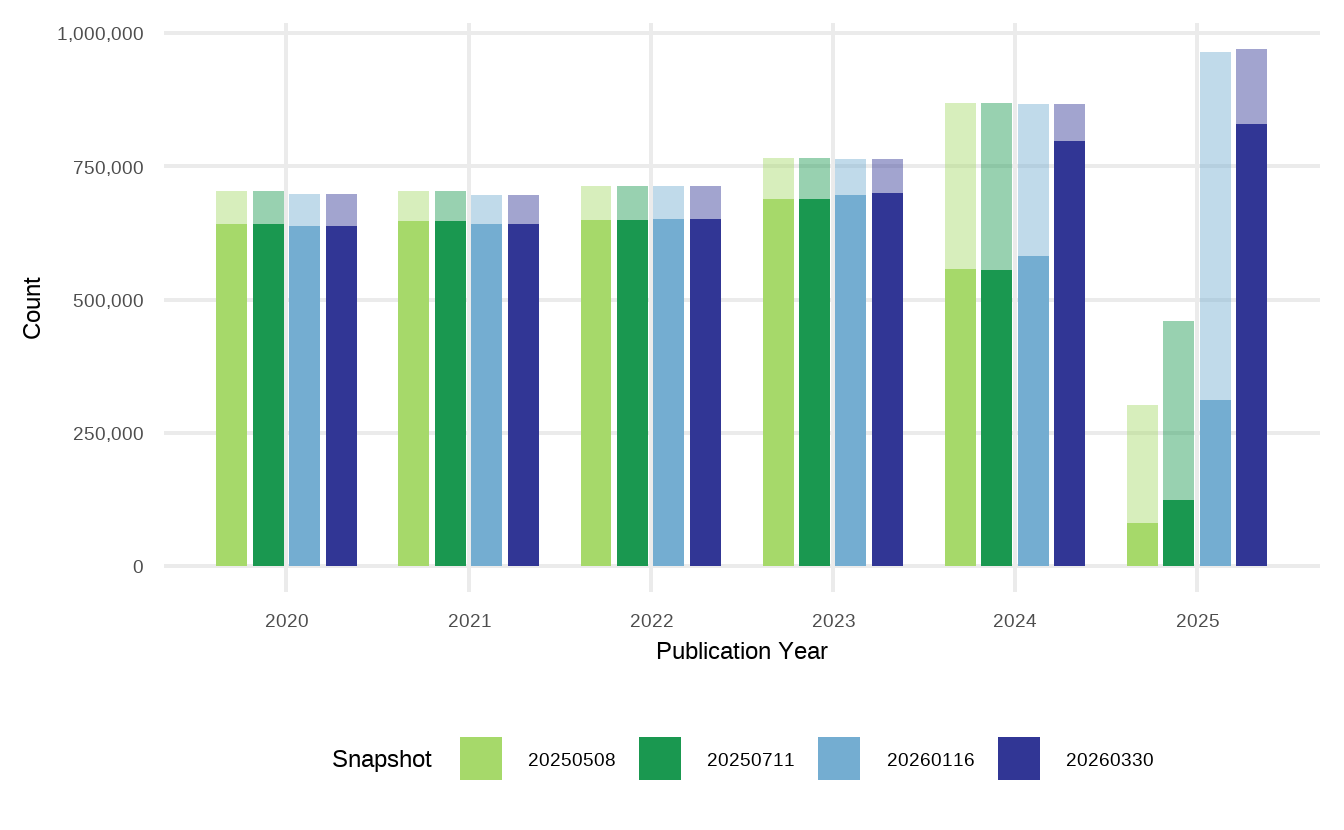
An analysis of the subset of articles from the publisher Elsevier in Figure 3 shows a different pattern. Affiliation coverage is generally high for these publications in OpenAlex. However, for publications from 2024 and 2025, the affiliation coverage was unusually low in the two pre-Walden snapshots and the January 2026 snapshot, but has greatly improved in the March 2026 data. Compared to the raw affiliation coverage of drop from 95% to 64% for 2023 Elsevier items in the November 2025 Walden snapshot of Jahn (Fig. 3 there), the coverage has increased in our slightly different data subset to over 91% in the two post-Walden snapshots.
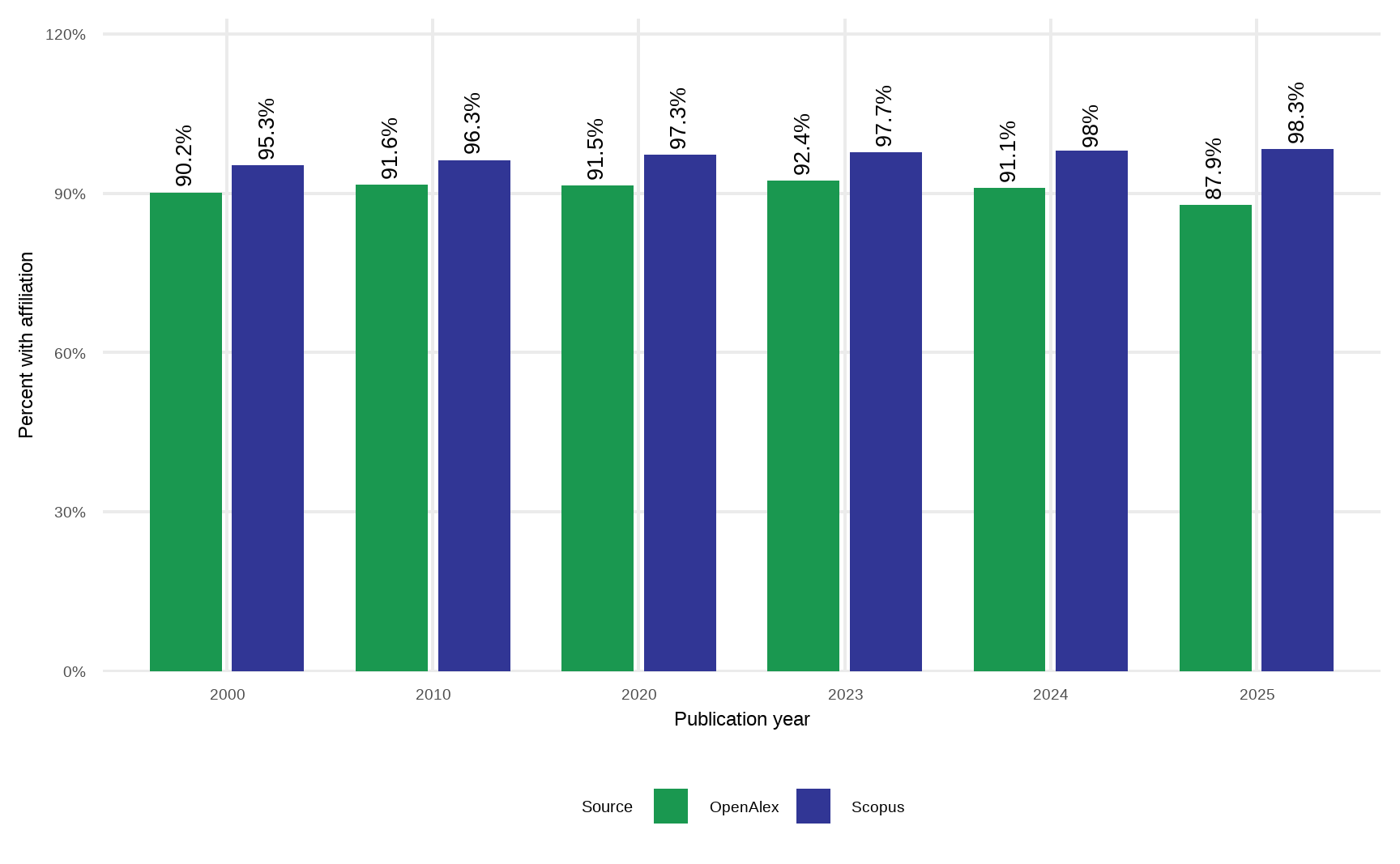
Finally, in Figure 4 we compare the affiliation coverage of the subset of items included in both OpenAlex and Scopus, as matched by DOI, for a longer period. Here we only compare the March 2026 OpenAlex snapshot to a Scopus snapshot from the same date. The data available in Scopus is slightly more complete, 5 to 10 percentage points higher, depending on publication year.
In summary, the large increases in covered items in OpenAlex seem to be restricted to records without affiliation data. Our surface-level analysis cannot show whether this is because no affiliation data exists in the source data or for other reasons. A temporary dip in the completeness of Elsevier affiliation data appears unrelated to the Walden code update, because it was observable in an earlier snapshot, but has been rectified in the more recent data releases.
These observations underscore the importance of independent third-party monitoring of the quality of open bibliometric data – one of the tasks of KB.
Citation
BibTeX citation:
@online{donner2026,
  author = {Donner, Paul and Schmidt, Marion},
  title = {OpenAlex Affiliation Data Coverage - {August} 2026 Update},
  date = {2026-08-28},
  url = {http://www.open-bibliometrics.de/posts/20260828-OpenAlexAffiliationCoverage/},
  langid = {en}
}
For attribution, please cite this work as:
Donner, Paul, and Marion Schmidt. 2026. “OpenAlex Affiliation Data
Coverage - August 2026 Update.” August 28. http://www.open-bibliometrics.de/posts/20260828-OpenAlexAffiliationCoverage/.